
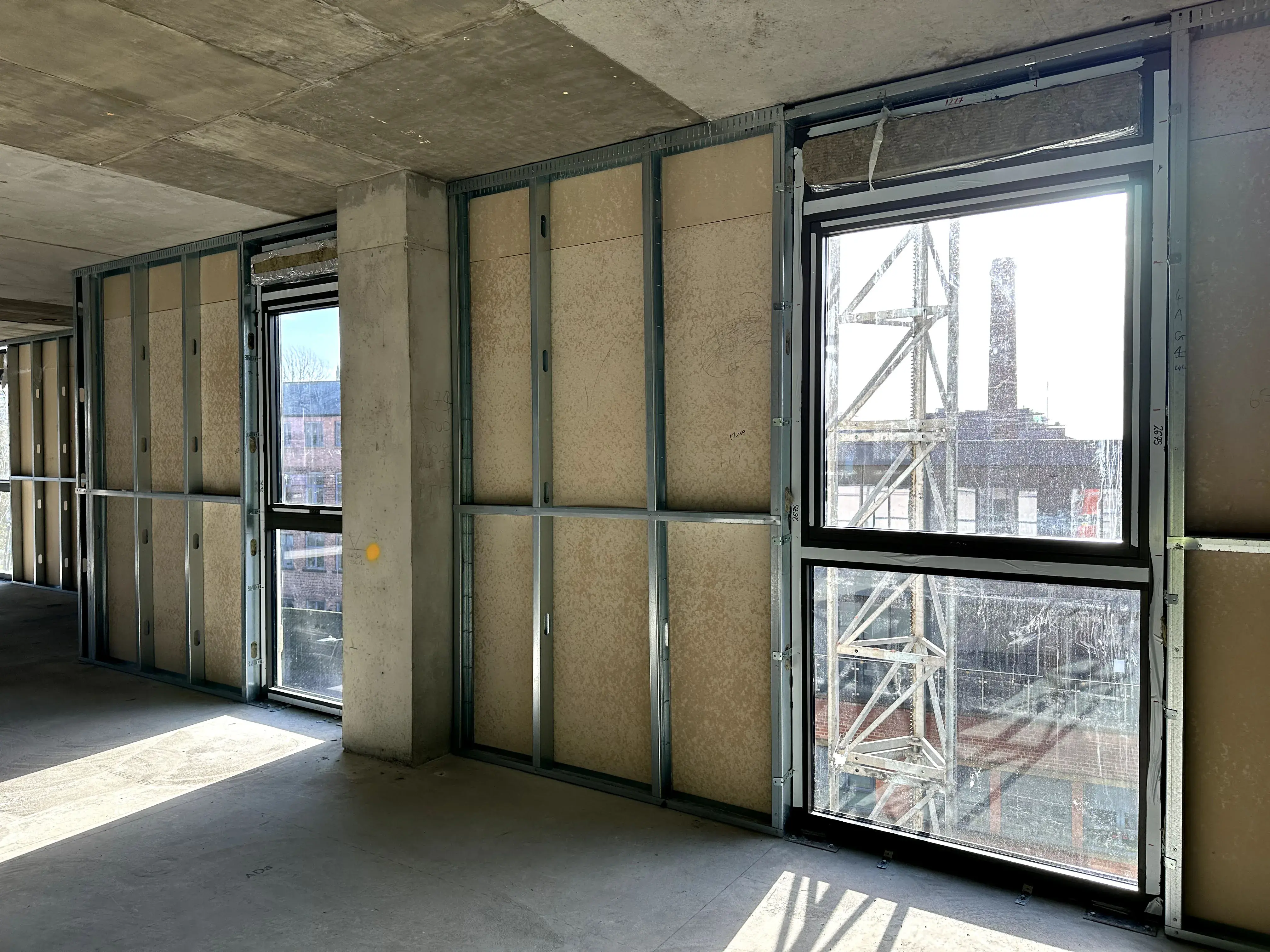
The advantages of steel framing systems (SFS) are often summarised in broad terms such as ‘speed’ or ‘strength’. This is true, but in practice, their value is more specific and tends to emerge through how they affect coordination, procurement, and downstream packages. The following six advantages reflect where steel framing systems most consistently influence project outcomes, particularly in relation to cost certainty, programme control, and façade integration.

1. Early definition of structural geometry
Steel framing systems establish a fixed geometric framework early in the programme. Because components are fabricated to precise dimensions, the installed frame becomes the reference point for subsequent trades. This reduces ambiguity for packages such as curtain walling systems, which rely on consistent setting-out data. Where geometry is locked in early, downstream detailing becomes more straightforward and less reliant on-site interpretations, reducing the risk of coordination issues and variation later in the programme.
2. Reduced reliance on site-based adjustment
One of the more practical steel framing system advantages is the reduced need for on-site modification. Traditional construction methods often rely on adjustment during installation to accommodate tolerances or incomplete information. Steel framing systems shift this effort into the design and fabrication stages. While this requires earlier coordination, it reduces the likelihood of improvised solutions on site, which are often a source of variation and inconsistency, helping improve cost predictability at tender stage.
3. Improved alignment with unitised façade systems
Steel framing systems are particularly well-suited to projects using unitised façade panels. Both systems depend on pre-defined dimensions and controlled fabrication, which allows them to be coordinated more effectively than mixed approaches. If this alignment is achieved, installation can proceed with fewer interruptions, as both the structure and façade are designed to fit within the same tolerance framework. This is one of the more specific advantages of steel framing systems when used as part of an integrated envelope strategy, supporting smoother installation and reduced programme risk.
4. Clearer package boundaries
The use of steel framing systems can help define clearer boundaries between construction packages. Because the frame is installed as a discrete element, it creates a defined interface for other trades to work on. This can simplify scope definition at tender stage, particularly where responsibilities might otherwise overlap. For example, the interface between structural framing and façade systems can be more clearly delineated, reducing ambiguity in design responsibility and limiting the potential for disputes or variation claims.
5. Greater predictability in sequencing
Steel framing systems enable a more predictable construction sequence. Off-site fabrication allows work to progress in parallel with site preparation, and installation follows a relatively consistent pattern once materials arrive. This predictability is not simply about speed; it also allows for more reliable planning of follow-on activities. Trades dependent on the frame can programme their work with greater confidence, provided that upstream design information has been resolved, supporting earlier follow-on trades and reduced prelim costs compared to traditional methods.
6. Concentration of technical risk
One of the less obvious advantages of steel-framed systems is the way they concentrate technical risk. Because the system is fabricated off-site, accuracy and performance are heavily dependent on the quality of design information and manufacturing processes. Where this is managed effectively, risk is reduced through controlled conditions and repeatable processes. Errors are more likely to be identified before installation rather than during it. However, this also means that unresolved issues at the design stage can have wider consequences once fabrication begins, making early coordination and clear design responsibility critical to reducing downstream risk.
Compliance And Performance Considerations
Steel framing systems can also support compliance with UK Building Regulations when properly specified and integrated within the façade package. This includes fire performance, thermal efficiency, and acoustic requirements. When delivered as part of a coordinated façade solution, SFS can contribute to a more consistent and compliant building envelope, while reducing the risk of performance gaps at system interfaces.
What Next?
To find out more about the advantages and disadvantages of steel-framed systems or to discuss your project requirements, discuss your upcoming project with Advanced Glass to explore how SFS can support cost certainty, programme efficiency, and façade integration.
